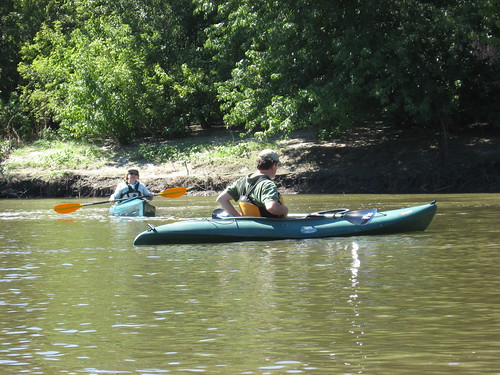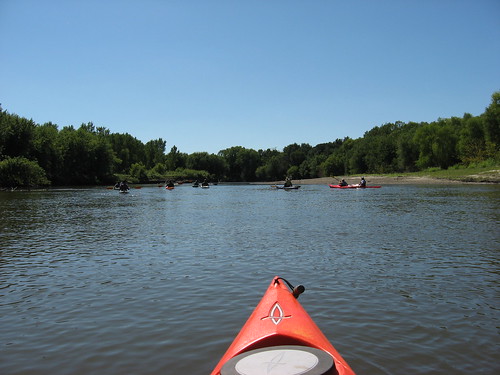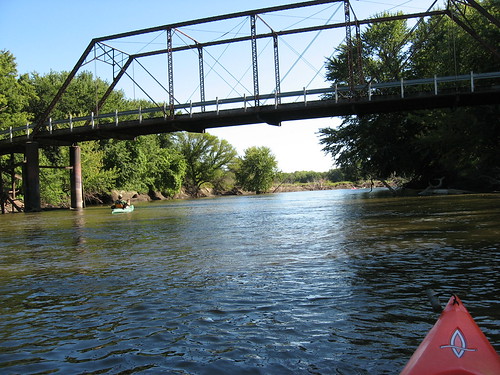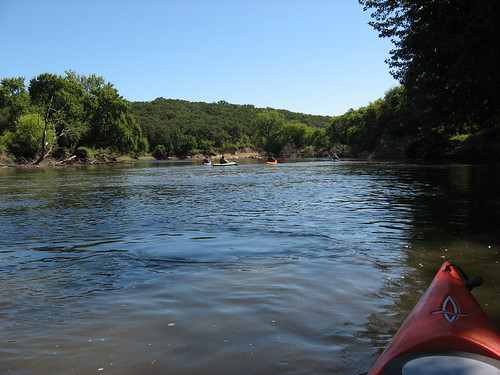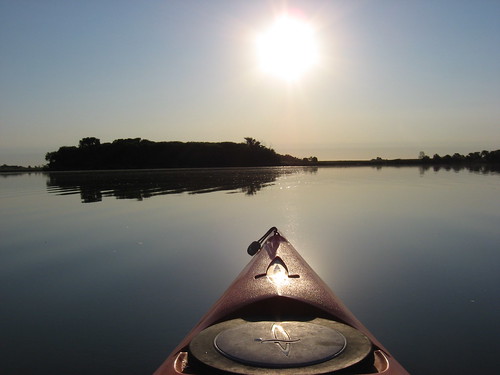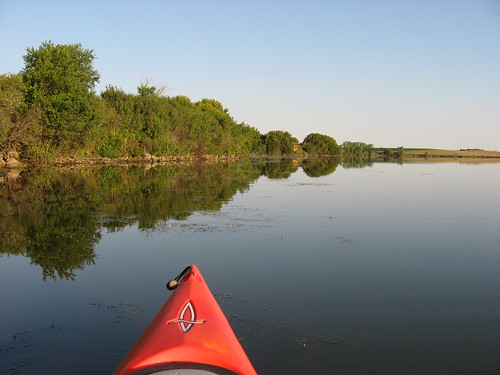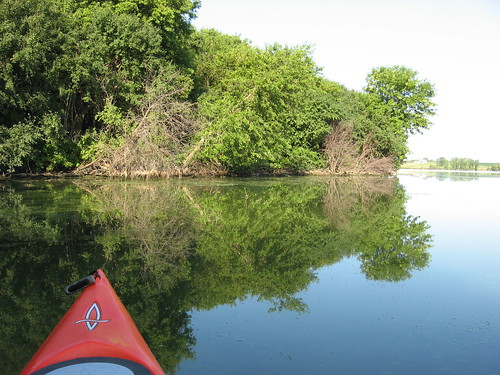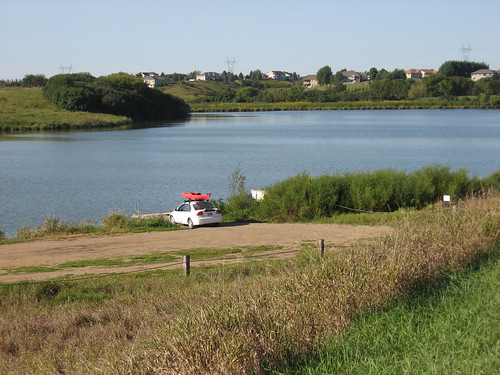
This blog is designed to highlight the paddling opportunities within South Dakota, mainly within a 50-mile radius of Sioux Falls. While Sioux Falls is far from the adventure of coastal regions, there is a certain satisfaction in utilizing the available waterways to observe weather, water conditions, and the landscape along the shoreline. In addition, there is a wealth of animal life on the waters of small South Dakota lakes, rivers, and creeks, including geese, ducks, pelicans, great blue heron, egrets, hawks, owls, perching birds, deer, raccoons, and beaver. Eagles, fox, and coyote are also sometimes spotted.

The sites described are places where I have kayaked over the past few years, mostly in South Dakota but sometimes including locations in Iowa and Minnesota. One of the best sources of information on the accessibility of small lakes is the South Dakota Atlas and Gazetteer, the large map book of South Dakota. Lakes with a public access are generally identified by a boat symbol marking the location of a launching site on public land.

You will notice the menu of paddling locations on the right side of the blog. Each of the postings is linked to one of the areas, and my intention is to provide a continuing review of the places where I paddle. Perhaps these narratives will help readers select waterways of interest to them. Please feel free to offer a comment regarding any of my postings; I would welcome the dialog.

I also maintain a companion blog that describes hiking opportunities within the Sioux Falls area. You can access that blog at: http://hikingsiouxfalls.blogspot.com

Wednesday, September 07, 2011

Lake Alvin: September 2011

IMG_6678.JPG

With a wonderful early fall forecast ahead after the Labor Day cruise on Monday, I just left my kayak on the car ready for another cruise this week. So, this morning I headed out to the very familiar waters of Lake Alvin for a trip along the shoreline.
IMG_6688.JPG

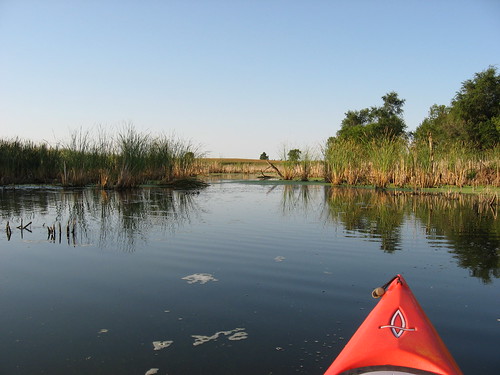
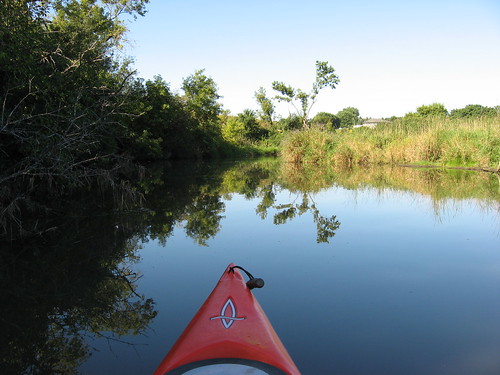
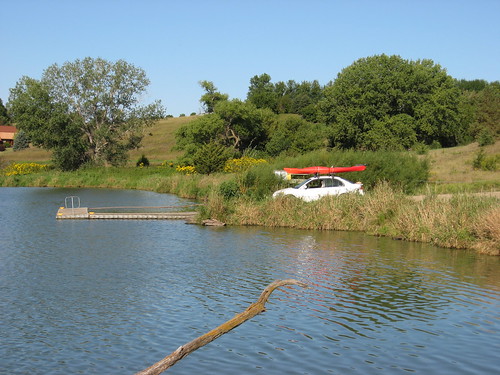
Putting in at the southwestern public access site, the lake was deserted. Unable to resist my habitual path, I headed south into Nine Mile Creek and continued upstream for about 30 minutes.
IMG_6696.JPG

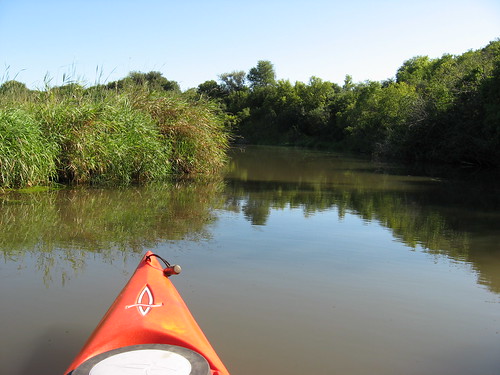
The depth of the channel was satisfactory along this route, although some attention had to be paid to avoiding grounding at times. I was able to continue upstream on the creek nearly to the point where it becomes too shallow and rocky most of the year. So, the creek is deep enough still for kayaks to move up on the usual route for about a mile and a-half.
IMG_6692.JPG

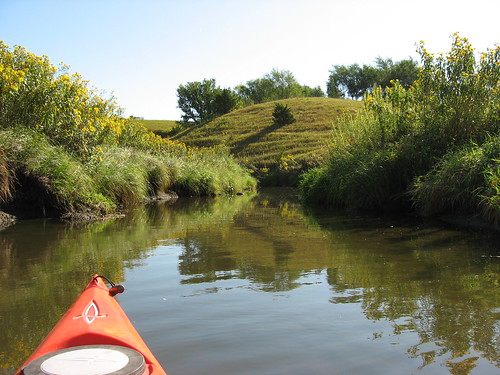
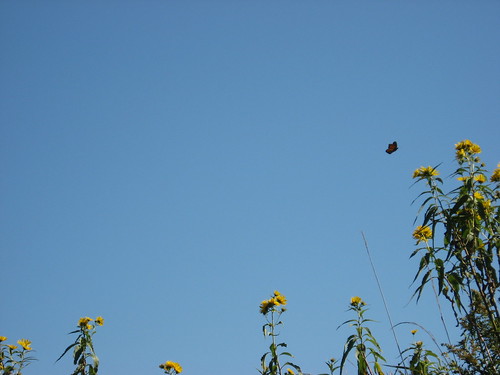
I like moving up and down these narrow creeks with high banks, with deep native grasses and wildflowers and the dappled shade provided by trees along the bank. Unlike the spring cruises on Nine Mile Creek, there was no waterfowl to be seen today and only a few other birds. I did see some turtles and a couple of muskrat and lots of butterflies, dragonflies, and bees flitting among the yellow wildflowers.
IMG_6694.JPG

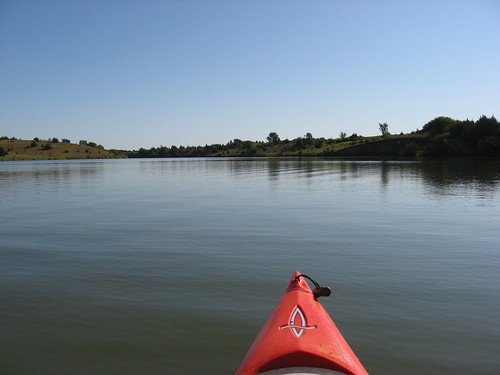
After returning from my creek cruise, I continued north into the main body of Lake Alvin. Moving in the shade along the eastern shore, I paddled north, peering into the vegetation along the shore.
IMG_6683.JPG

It was not until I arrived in the northern half of the lake, across from the recreation area boat launch, that I saw any other human activity. A fishing boat was putting into the lake as I passed and there were a few cars parked in the lot. I came across a fisherman casting from his boat and spoke to him. He was startled and said that I must have snuck up on him.
IMG_6697.JPG

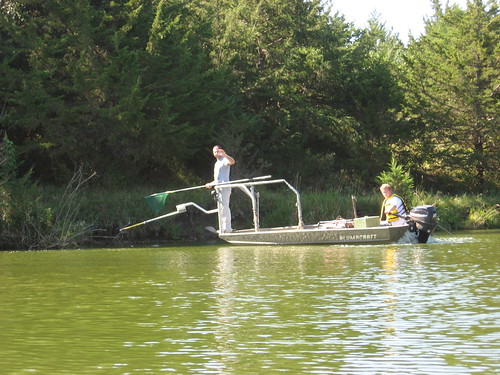
As I continued north, I came across a strange looking boat. It had a high pulpit around the bow and an arm extending out from the bow with a round looking device suspended from a cable. There were two guys in the boat, and one was using a net. As I approached the boat, I asked what kind of rig they were using. One of the guys told me that they were “electro-fishing” and were from SDSU on a research project. Apparently, they were stunning fish with a shock of some sort, netting them, and then measuring and perhaps tagging them. They told me that it would be a good idea if I stood off from their boat, presumably to avoid being shocked by the device.
IMG_6700.JPG

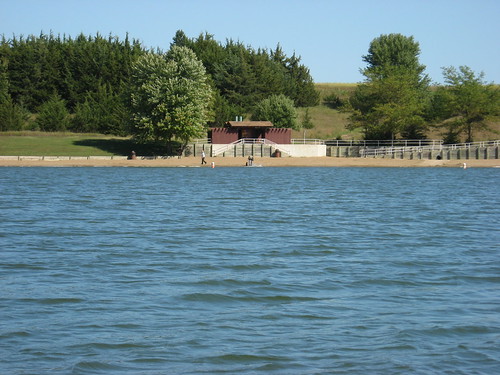
Continuing on, I moved along the eastern shore to the northern end of the lake and then began my cruise back to the south end. As I passed the public swimming beach, I saw a couple of people exercising their dogs in the sand, retrieving something from the water.
IMG_6684.JPG

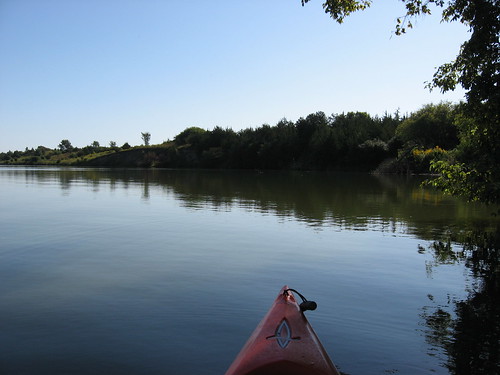
The cruise this morning was under really ideal conditions. It was sunny, the temperature was about 68 degrees, and there was a light wind out of the south. The lake was quite clean. I had to search to find my cruise quota of five pieces of debris, generally plastic bottles. There was very little algae on the surface, and the lake is likely to become even clearer as the fall deepens. I had a fun two hours on my morning cruise.
IMG_6681.JPG

Tuesday, September 06, 2011

Labor Day on the Big Sioux River

IMG_6651.JPG

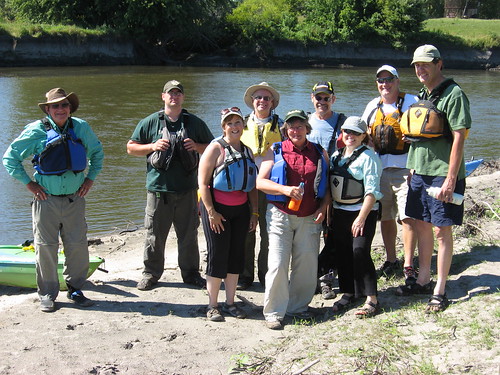
Dave and Mary Finck and Larry Braaten, officers of the SDCKA, announced Sunday that they were setting out on a Labor Day cruise down the Big Sioux River from the Klondike Dam to the Highway 18 bridge just east of Canton, SD, and invited interested members to join them.

IMG_6616.JPG

I realized that this was an opportunity not to be squandered, a chance to join with the group and enjoy the fellowship of the paddle, have access to a shuttle, and laugh it up in the sun on this really wonderful day. The winds were light, the skies were sunny, and the temperature in the low 70s. In addition the water conditions were as good as they could be: plenty of depth, a wide and steady flow, no strainers, and no rapids.

IMG_6618.JPG

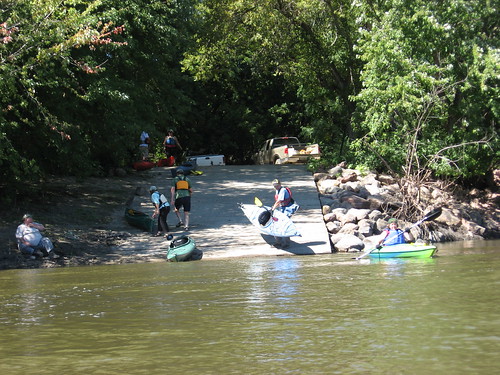
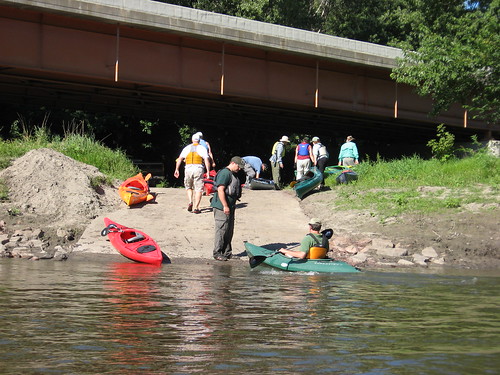
We gathered on the South Dakota side of the river and dropped off our kayaks at the established launch area. Eight of us drove down to the take-out to leave our cars and then piled into Dave Finck’s van for the ride back to the Klondike. There were ten kayaks in our flotilla, and we began our eight-mile paddle about 2:00 p.m.

IMG_6624.JPG

After launching, the kayaks milled around the put-in until everyone was afloat, and then we set off downstream.

IMG_6620.JPG

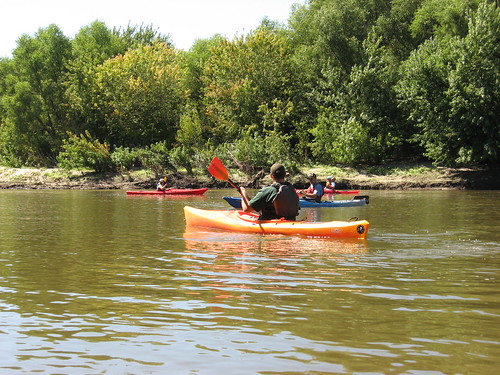
These group paddles tend to begin with kayaks bunched up, but then a separation occurs and three or four conversation groups seem to form and reform over the course of the trip.

IMG_6625.JPG

I was the last kayak in line as we set out. As I stopped to take photographs at times, the distance between me and the group tended to lengthen.

IMG_6659.JPG

Sometimes, I found that no other kayaks were in sight. It was almost as if I were alone on the river; then I would put some power back into the stroke and move up to at least another kayak. One of my kayaking pals, Jarett Bies, helped me understand that the power in a stroke is in the pushing of the paddle rather than pulling. Keeping that in mind, I would ensure that my hands were low on the paddle shaft and drive forward a hundred strokes or so until I spotted the most distant kayak ahead.

IMG_6628.JPG

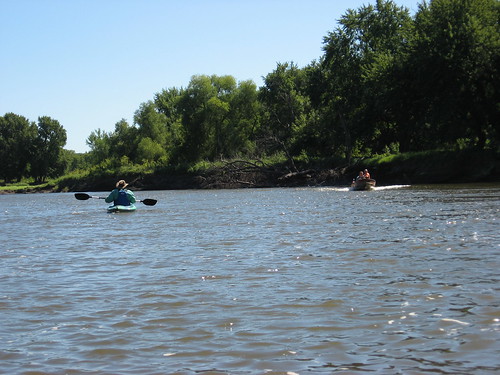
On this Labor Day, we saw some fishermen out along the banks, we passed a family that had built a bonfire and seemed to be settling in for a picnic, and we even came across a motorboat filled with fishermen heading upstream – one of the rare times that I have seen a powered craft on these small South Dakota streams.

IMG_6635.JPG

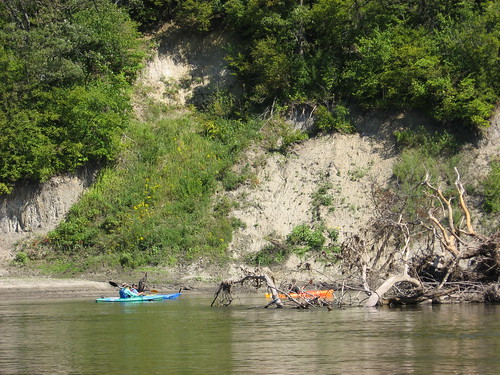
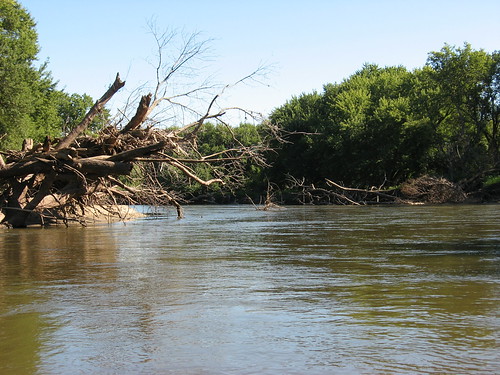
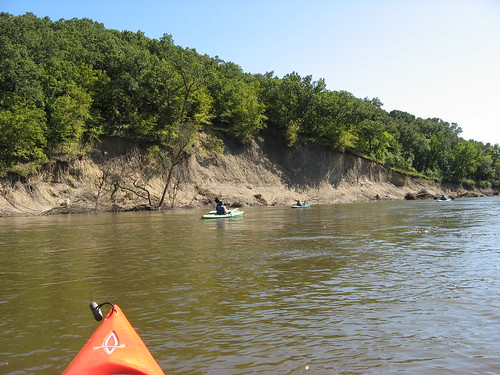
This stretch of the Big Sioux is wide and the banks are heavily covered with trees. There are rolling hills along both sides of the river and some steep banks at times, especially along the Iowa side. The banks have been undercut with the floods this year, and it is easy to see future strainers hanging on to their probable final year of growth with roots exposed and hanging down. There are also rugged large tree skeletons in the water, evidence of trees that once graced the riverbank before being eroded through spring floods.

IMG_6640.JPG

IMG_6667.JPG

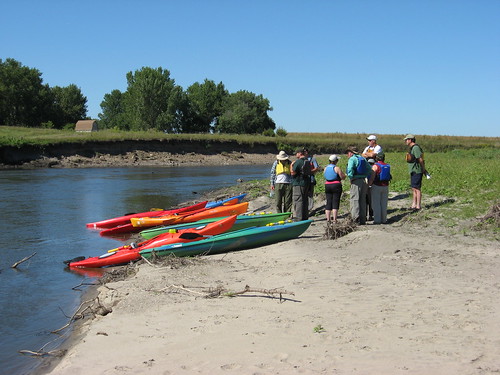
There are several sandy beaches scattered along this course of the river, and we stopped along one for a few minutes to take a short break. These few minutes provide a chance to connect with each other and enjoy a moment of fellowship.

IMG_6654.JPG

There were no “critters” to be seen today and only a few birds. The sounds of a group paddling downstream tend to provide a clear announcement to the animals that their space is being invaded, even though we are all harmless people – environmentalists by nature of our kayaks.

IMG_6656.JPG

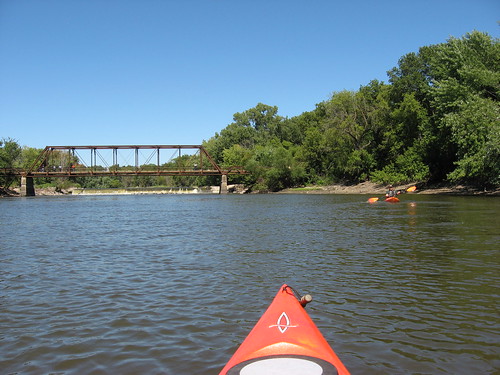
We arrived at the Highway 18 bridge after about two and a-half hours on the water. There is an easy take-out at a launching area just down from the bridge on the Iowa side of the river.

IMG_6676.JPG

This was a great trip, a beautiful day at the beginning of the informal fall season. Many of us were conscious of the changing season. The leaves are about to start falling, and all of us know the signs of the fading summer and the hint of what is about to befall us here on the northern plains. Winter can be here as early as October – next month!

IMG_6648.JPG

Thursday, August 25, 2011

Beaver Lake - August 2011

IMG_6572.JPG
The forecast yesterday for this morning seemed the best this week for kayaking: light winds, sunny, no rain. So, to lock in my intentions, I loaded up the kayak on the car last night so that I might make a quick getaway after my bagel, coffee, and hour-long read at my routine morning spot.
IMG_6571.JPG
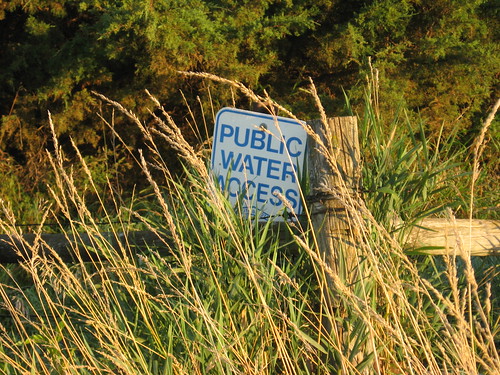
I wanted to revisit Beaver Lake, a body of water that I last paddled in May, just as the area was experiencing the arrival of spring. Beaver Lake is about 25 miles from my eastside Sioux Falls home and an easy drive out on Interstate 90 to Humboldt. The lake is about 300 acres, roughly three times the size of Lake Alvin. As I arrived in Humboldt this morning looking for the gas station that marks the road leading past the cemetery and the back of the elementary school and on to the lakeshore, I thought about how hard it would be for someone to actually locate the lake. Signage is not a strength here in South Dakota, especially when searching for a lake. There is nothing indicating a lake or launching area until passing an obscure small sign covered in weeds, and there is almost never a sign providing a name for a lake. Perhaps this is to keep such locations nearly private, only accessible to those in the know. Specific driving directions from Sioux Falls are provided on earlier narratives located in the area waterways inventory on the right side of this blog.
IMG_6576.JPG
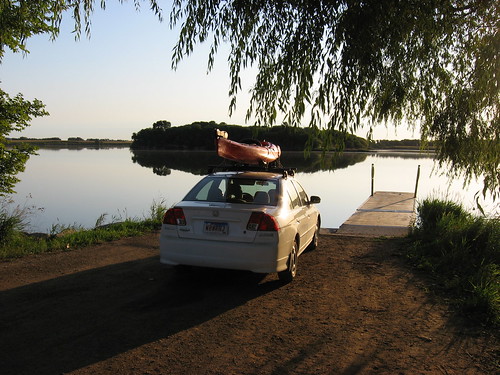
The launch area is quite nice and has a ramp, dock, ample parking, and a vault toilet. There was no one about, neither on the shore nor on the water; I was completely alone for my cruise.
IMG_6574.JPG
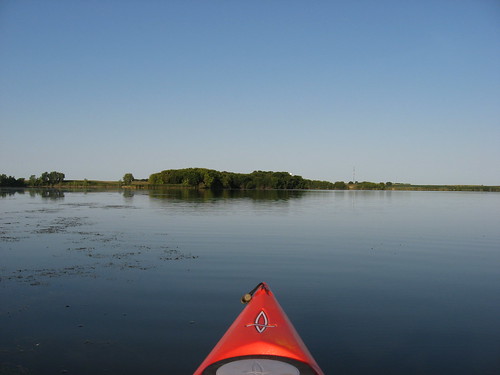
I launched my kayak at 7:45 a.m. into mirror calm waters. This lake can be quite a challenge when there is a stiff wind, but today it was just beautiful. I rushed through my readiness steps so that I could get underway before a wind arose to shatter the reflective surface.
IMG_6611.JPG
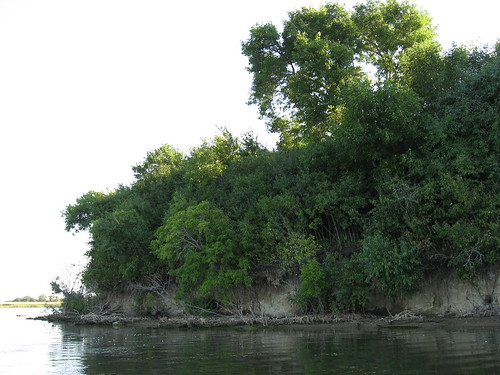
My usual route on Beaver Lake is to take off from the launching area on the southern end of the lake and head out to the island directly in front of the ramp. The island is heavily wooded with a varied shoreline. The southwestern side has high cut banks, perhaps up to 20 feet in height, while the eastern and northern shoreline is gently shelving into a thickly wooded interior.
IMG_6612.JPG
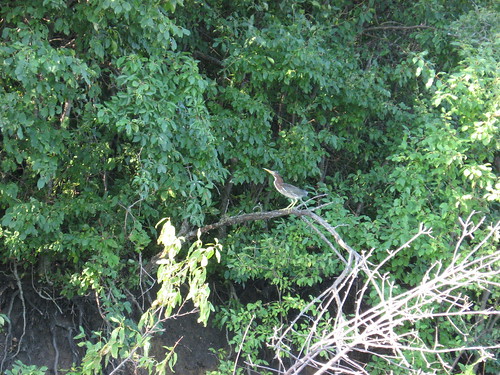
The island is a bird paradise. I have seen great blue heron, egrets, owls, geese, ducks, and a great variety of perching birds. There does not seem to be any clear path into the interior of the island. I suppose that there is some animal life that either swims to the island or is stranded after crossing during the winter, although I have seen only squirrels.
IMG_6606.JPG
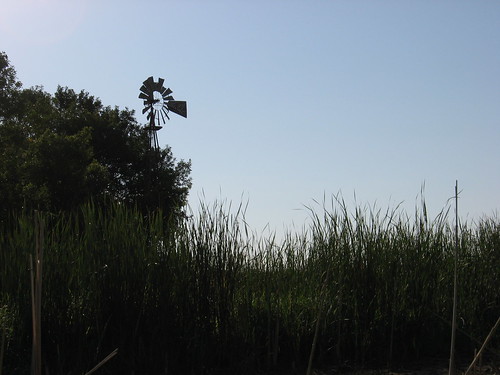
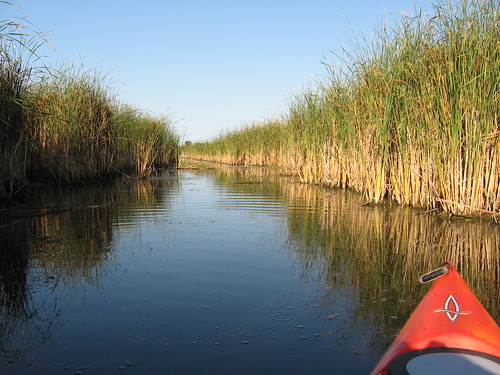
As nearly always, I paddled out to the island and went right around the eastern shore to the north and entered the northeastern arm of the lake. Keeping to the right side, I paddled close along the shore until I came to the channel, marked by an old windmill, leading south about 1,000 feet into a large marshy pool.
IMG_6581.JPG
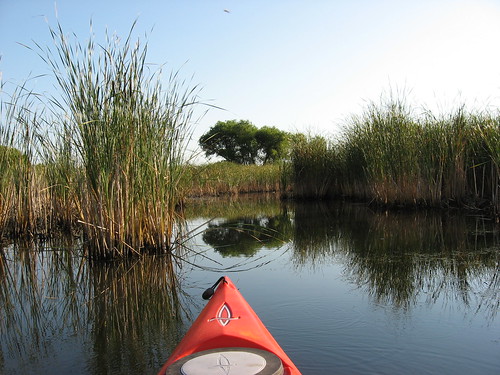
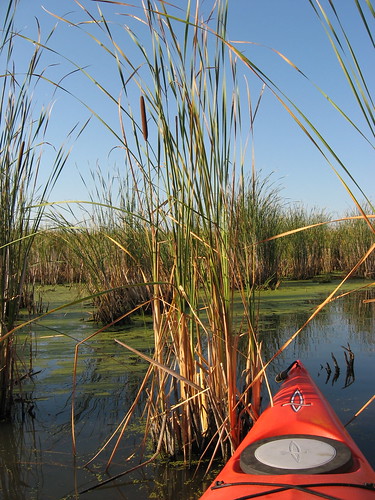
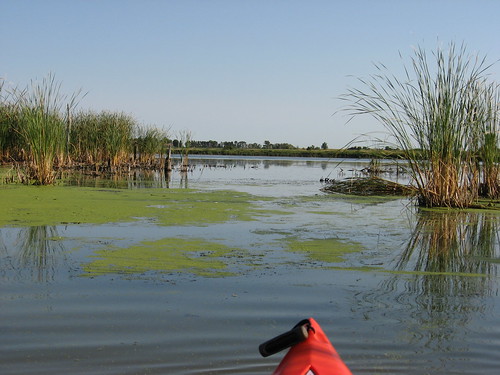
This pool is deep in the marsh and bordered by tall rushes and cattails. There are beaver lodges aplenty throughout the channel and the pool. Also, this is a nesting area for a great variety of waterfowl and perching birds.
IMG_6599.JPG
I like to ground my kayak among the rushes and sit quietly watching the reappearance of birds that took flight initially upon my arrival.
IMG_6596.JPG
Sitting there in the pool is a great vantage point for observing the life of this secluded spot.
IMG_6581.JPG
Even though the lake has lost some depth at this point in the summer, there was plenty of water to float my kayak anywhere I wanted to go.
IMG_6603.JPG
After my cruise through that channel and into the pool, I reentered the eastern arm of the lake and continued east to the end. On the north side of the very end of this arm, there is another channel that flows northeast and allows passage for about 800 feet through the marsh and rushes. As always, I continued up this channel until my forward progress was halted by a single-wire fence. This channel was pretty shallow with depth ranging from just a few inches to perhaps one or two feet. As I thrust my paddle down, it sank into about a foot of muck. I did not want to be in a situation where I had to get out of a grounded kayak and find myself flailing around in muck that reached my knees. But, this did not happen, and I continued as usual until I reached the wire.
IMG_6615.JPG
Coming back, I returned to the island and continued around the remaining shoreline, peering into the interior and impressed by the constant cacophony of bird calls – calls from unseen birds deep in the woods.
IMG_6579.JPG
I was out for about two hours this morning. While I was out, the mirror calm was replaced by a surface sculpted into wavelets from a developing light breeze. Again, the inescapable lesson of lake cruising in South Dakota: go paddling early!
IMG_6609.JPG
Beaver Lake is a very nice spot for varied landscape and bird watching. As the reader might review in earlier narratives (see the inventory of specific paddling areas on the right side of the blog), this is also a lake that can become dangerous when the wind rises. I have a paddling colleague who goes out to Beaver Lake during windy conditions specifically to ride the waves, but I prefer a calm water surface, especially when out alone. My tip-off for going to Beaver Lake is a forecast that calls for winds from 5-15 mph, and then I go early to take advantage of the calmest part of the day.